For years I was tired in a way sleep did not fix, really small things irritated me more than they used to, and even simple decisions felt heavy. Throughout my life I have found that overwhelm won't arrive on one particular day, it can creep up unexpectedly or just be hanging around in the distance waiting to pounce.
Before it feels like too much, there is a period when small things start to go slightly wrong, and that period is the best time to act. I wanted to go through and list the early signs, explain why they are so easy to explain away or ignore, and show you how to write a response for each one in advance, so that on the day you notice it you already know what to do.
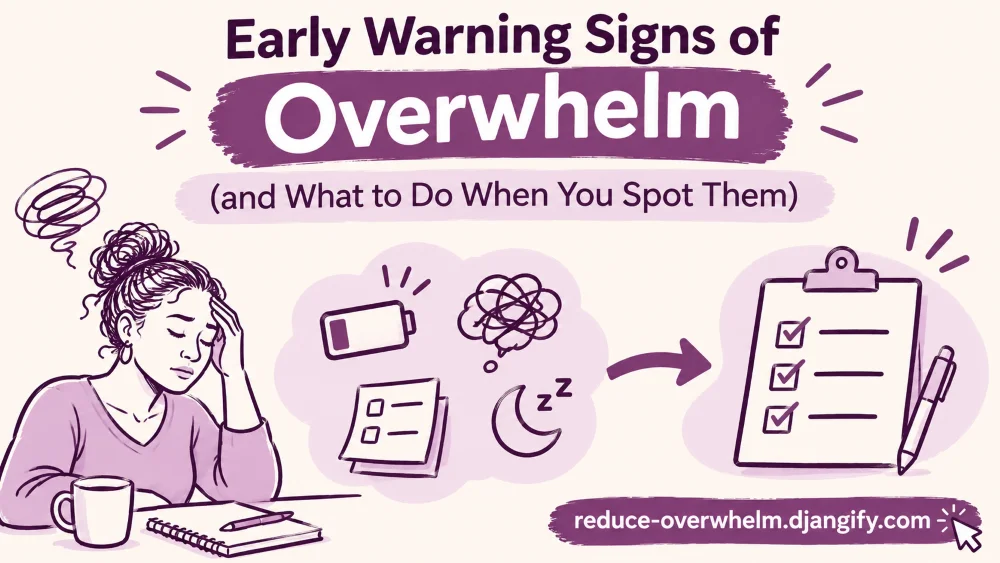
- The first signs are quiet: irritation at small requests, avoided tasks, later bedtimes, constant phone checking and a noisy head.
- They are easy to miss because each one has an ordinary explanation and capable women expect to cope.
- Most signs point to a head that holds too much to track, carry and choose, with the loss of structure underneath.
- Write your top three signs with one small response each, so you already know what to do.
The signs that show up first
These are the quiet ones that don't look like a problem on its own, which is why they get explained away or ignored until they become a problem. Here are the five that I used to experience on a regular basis so I included them in my Overwhelm guide, with what tends to sit underneath each.
Irritation at small requests
A message asking for something simple lands like an imposition so I'd reply, but my answer was shorter and sharper than I meant it to be or would usually be. I found that when my head is already full, every new request arrives on top of everything you I am holding, and it feels bigger than it is. If this is your first sign, the pattern behind it is often an automatic yes. Boundary Installation for Responsible Women looks at how availability expands until every request feels heavy.
Avoiding simple tasks
The job that would take ten minutes keeps moving to tomorrow, was a common one for me. Small tasks are easy to postpone (and ignore) because they never feel urgent, and they stay open in the background of my mind. Each one opens a loop that takes a little attention, and a week of them adds up. Suddenly I found myself with a bunch of tiny, non urgent, simple tasks living rent free in my head and distracting me.
Sleeping later but feeling less rested
There were some days when bedtime would slide as I went to bed later and later. I don't really have a strict bedtime anyway so that never helped but going to bed at 10pm turned into 11.30pm then 2am - especially if I found myself scrolling late at night. On the flip side the extra time in bed doesn't buy me any extra energy I still woke up feeling tired. My guide names this as part of structural drift: routines fade, sleep gets inconsistent, boundaries blur and you start reacting instead of choosing. You can read more about how that builds in How Structural Drift Creates Mental Chaos.
Reaching for your phone constantly
This one is common for so many of us working online. I pick my phone up without a reason and put it down without having done anything. When I feel overloaded, I tend to reach for short-term relief such as scrolling, snacking or distraction. The guide is clear that these habits are not laziness but attempts at soothing, and that makes them useful signals once you see them for what they are.
A noisy head with nothing urgent happening
There are some days when my calendar is fine but my mind still won't settle. This one points most directly at mental load, the layer of overwhelm that is too much to track. Even when you are not actively thinking about the appointment next week or the message you forgot to answer, your brain keeps them running in the background.
Later signs, when it has been building for a while
If the first signs are missed or ignored, a second set tends to follow:
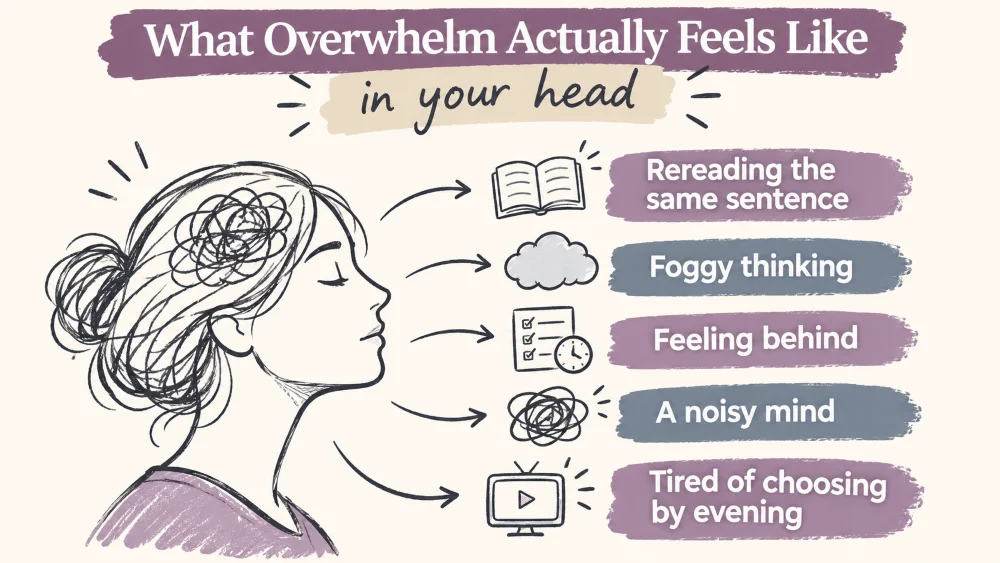
- You are tired in a way that sleep does not fix.
- You reread the same sentence three times.
- You feel behind even though you are constantly doing things.
- You snap more easily, and your phone lighting up brings a low level of dread.
- By evening, even choosing what to watch feels like work.
The last one is decision fatigue. Every small choice draws on the same energy, and by mid-afternoon you can be drained because you chose too much and not because you worked too hard. What Overwhelm Actually Feels Like describes the whole picture across your head, body and week.
By the time you are here, the pattern has usually been running for a while. It is still reversible, and it is a good reason to catch the earlier signs next time so you can learn to respond differently.
Why they are easy to miss
Every sign on the list has an ordinary explanation. You were short with someone because it was a long week. You scrolled because you needed a break. You slept badly because of the weather.
There is a second reason that affected me directly and that was the belief I had that I should be able to handle this. If you are the capable one, the person who answers fast and remembers the details, you tend to treat your own warning signs as a personal failing. Or at least that's what I do so instead I push through, become more reliable, and the load grows. Why Capable Women Experience Overwhelm explains why the most dependable people often carry the most.
I tried traditional therapy, and it didn't give me the relief I was hoping for but I am not going to spill my guts on the internet and talk about why not because that's personal to me and therapy works for many. Because of my personal experience I spent more than a decade reading embracing self-help, researching and testing strategies on my own life, outside a clinical setting. I wrote my guide and put the result in one sentence: most of the time, nothing is wrong with you, and you are simply carrying too much in your head.
What the signs point to
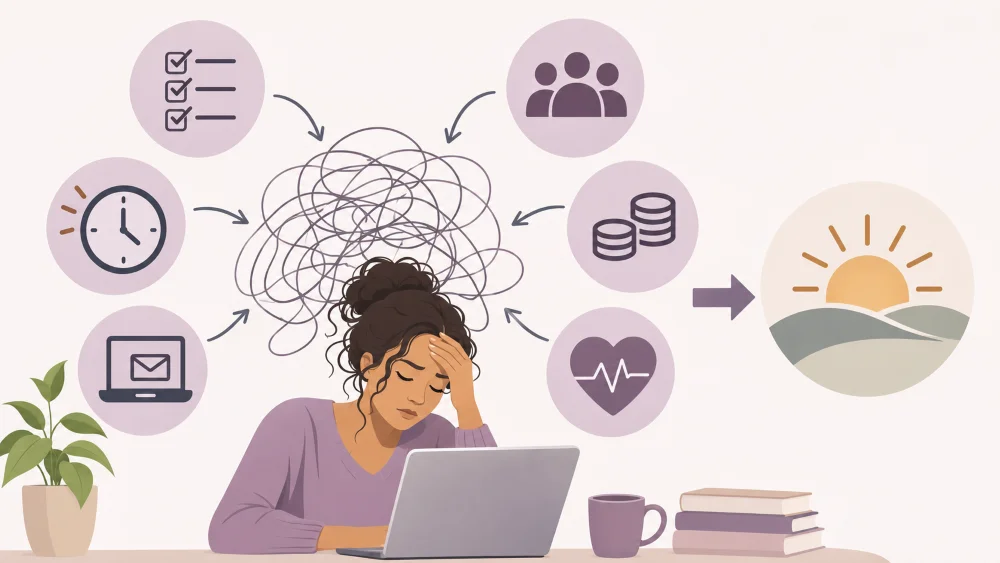
Most of these signs come from the same place: your head is holding more than it can from a combination of things that will all have its own early signs.
- Too much to track. A noisy head, avoided small tasks, the feeling of being behind. This is input overload.
- Too much to carry. Irritation, snapping, dread when the phone lights up. This is the emotional weight of trying to be the together one.
- Too much to choose. Evening decisions that feel impossible. This is decision fatigue.
I also found there was a fourth thing that sits underneath all three, which is the loss of structure. When routines, boundaries and weekly reviews fade, your head tries to do the tracking that nothing else is doing. The 3-layer model of overload lays this out step by step, and the Reduce Overwhelm complete guide shows how the pieces fit together.
Seeing it this way removes the blame. It becomes a load issue and not a personality issue, which is also why a new planner rarely helps and if your head stays busy even after the load comes down, Overthinking vs Overwhelm explains how to tell a heavy load from a thought loop.
Read your own pattern
The signs above are a starting point. Yours may be different, and you will see them more clearly if you look at the load directly. I use an Overwhelm Snapshot that takes less than two minutes.
- On a scale from 1 to 10, where 1 is calm and steady and 10 is stretched thin and on edge, write down where you are right now.
- Ask where you feel it most: in your head, in your body or in your schedule.
- Rate three areas separately from 1 to 10: mental load (how crowded your mind feels), decision load (how tired you are of choosing things) and structure (how steady your days feel).
You may find that your mental load is an 8 and your structure is a 4, or that your structure is fine and the emotional pressure is high. Separating the pieces can lower the number slightly, and it shows you which sign to watch first. The free Overwhelm Self-Assessment walks you through the same ratings on screen.
If scattered time is one of your signs, for three days, write down what you actually spent most of your time on, and whether it matched what matters to you. You may find your days are not empty but fragmented. The Psychology of Time Leakage explains how those small leaks add up.
Write your own three signs and a response for each
Everyone's early signs are slightly different. The useful part is knowing yours and having a response ready, because a prepared response lowers panic and turns a reaction into intention.
- Look back at the last time your head felt too full. What was the first thing that changed, before you called it a bad week?
- Write down your top three signs.
- Next to each one, write one simple response.
These are three examples for you:
- When I start procrastinating simple tasks, I do a 10-minute clear-out.
- When I feel irritable, I check my sleep and remove one commitment.
- When I scroll excessively, I move my phone out of reach or don't bring it into my bedroom at night.
Keep the responses small enough that you will actually use them.
Your three signs and a response for each
- What was the first thing that changed the last time your head felt too full?Think back to before you called it a bad week.
- Sign one, and your responseFor example: when I avoid simple tasks, I do a 10-minute clear-out.
- Sign two, and your response
- Sign three, and your response
What to do this week
You do not need to fix your whole life when you notice a sign. Match the sign to a small action and take it this week.
- If your head is noisy, empty it onto paper. How to Do a Brain Dump That Works When Your Head Is Full shows you how.
- If everything feels heavy, list what you have said yes to and mark what gives you energy and what feels heavy. How to Audit Your Commitments Without Emotion walks through it.
- If you keep saying yes automatically, ask what you are saying no to if you say yes to this: time, rest, focus or recovery. How to Say No Without Guilt When You Are the Dependable One gives you the wording.
- If the days feel scattered, choose one task, set a timer for 25 to 45 minutes and remove visible distractions. The Discipline Method for Reducing Daily Cognitive Load covers the thinking behind it.
- If you keep slipping back, schedule a weekly 20-minute reset. Why Weekly Structure Prevents Relapse Into Overwhelm explains why a fixed slot matters.
If you notice several at once
If you are like me and see yourself in all of those in that list then you don't need a long plan. Overwhelm will return at times, because busy seasons and emotional seasons both happen, and the aim is dealing with it in the moment so you recover faster. Go back to three things, and do them within 24 hours, because delay adds to the mental noise:
- Empty your head onto paper.
- Remove one commitment.
- Rebuild your weekly shape.
Your rapid reset
- Empty your head onto paperWrite down every open loop.
- Remove one commitmentChoose the one that feels heaviest.
- Rebuild your weekly shapeGive the week a basic structure.
That is how I use what I call a rapid reset day. The free Personal Reset Plan walks you through exactly those three steps in one sitting, with no sign-up.
- Early signs are small and ordinary, which is why they are missed. Watch for irritation, avoided tasks, later bedtimes, phone checking and a noisy head.
- They usually point to too much to track, carry and choose, with the loss of structure underneath.
- Write your own top three signs with one small response each, and use the three-step reset within 24 hours when several show up together.
IMPORTANT DISCLAIMER: These are everyday signs and not a diagnosis. I am not a doctor, therapist or certified coach, so if heavy tiredness or low mood lasts for weeks, please speak with a qualified healthcare professional.