Chronic overwhelm was part of my life for more than ten years, and from the outside I looked as though I was coping. That is part of why it is so hard to describe, because it rarely looks like anything other than a busy person getting on with things. Inside, I felt tired in a way sleep did not fix, I was irritated by small things that never used to bother me, and I was weighed down by decisions that should have taken seconds.
I wrote this post for anyone searching for what overwhelm actually feels like. That search usually comes from a place where you are still functioning, but not in the way you used to, and without a good name for it. So I have set out what it looks like across the head, body and week, why it gets explained away so easily, and the three layers I see underneath it.
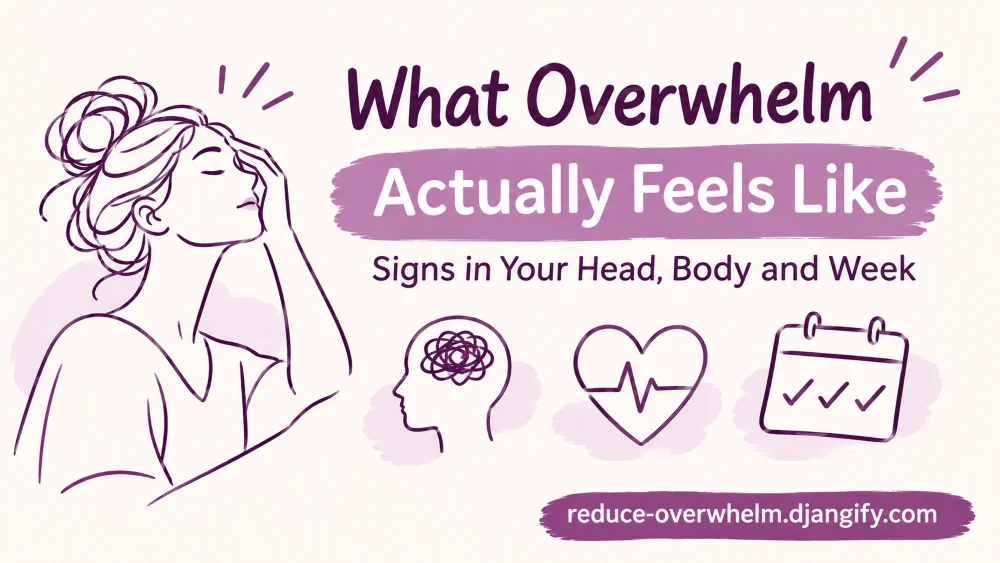
- Overwhelm shows up in the head as foggy thinking and a noisy mind, in the body as faster reactions and a low level of dread, and across the week as routines that slowly loosen.
- It gets explained away because capable women tell themselves they should be able to handle it, which is the thought that keeps them carrying more.
- I see three layers underneath it, too much to track, too much to carry and too much to choose, with the loss of structure sitting beneath all three.
What overwhelm feels like in the head
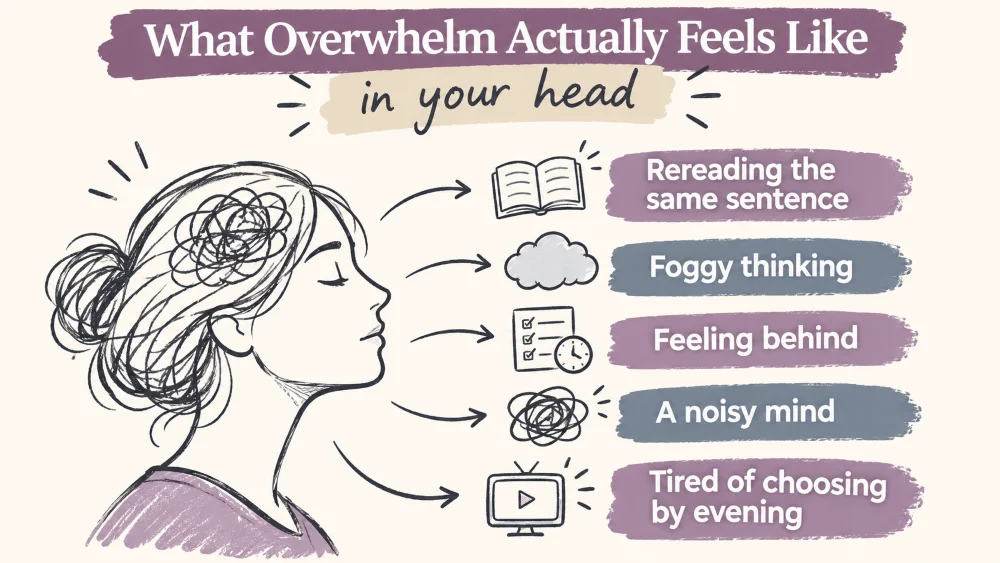
In my guide I describe overwhelm as what happens when the brain is trying to manage more than it comfortably can. In the head I write about it as five signs that tend to arrive together. They are rereading the same sentence three times, thinking that feels foggier than it used to, a sense of being behind even while constantly doing things, a noisy mind when nothing urgent is happening and, by the evening, simple choices such as what to watch that start to feel like work.
The noise is the part I find most worth explaining. Even when I am not actively thinking about the appointment next week, the message I forgot to answer or the bill I need to remember, my brain keeps all of them running in the background. That constant tracking uses a surprising amount of energy. The quickest way I found to see how much I was holding was a brain dump, and I wrote about how I approach that in How to Do a Brain Dump That Works When Your Head Is Full.
[ADD AN IMAGE: a simple graphic of a head with the five mental signs listed beside it, in the site purple, sized for a Pinterest pin]
What overwhelm feels like in the body
The second layer in my guide is too much to carry. I connect it to the pressure to do things well, to be responsible and to be the one who has it all together. When that pressure goes on for long enough, the nervous system stays slightly alert, which works well for short bursts but was never designed to run all day.
When it does run all day, the signs I describe are reacting faster than you mean to, snapping more easily, and feeling a low level of dread whenever the phone lights up. Small requests suddenly feel big, and it becomes hard to remember the last time you felt properly off duty, because scrolling, multitasking and half resting do not count as rest. One question I included in my guide for this part is where I feel it most, in my head, body or schedule, because the answer shows where to look first.
Two questions for you
- Where do you feel it most, in your head, body or schedule?The answer shows where to look first.
- Which of the five signs in the head have shown up for you this month?
What overwhelm feels like across the week
Overwhelm also changes the shape of the days, and this is often the part people notice last. Routines fade, sleep becomes inconsistent, boundaries blur, and you start reacting instead of choosing. The day feels busy but scattered, with large blocks of it going on answering, responding and checking while small tasks sit on the list for days.
I call the slow loosening of structure structural drift. Because nothing dramatic happens, it is easy to miss. That is why I wrote How Structural Drift Creates Mental Chaos about how it builds, and Early Warning Signs of Overwhelm about the signs to watch for before it gets heavy.
I remember working in a job that fired its Project Manager and then asked me to temporarily cover a few client-facing meetings. That was fine because I was the capable one after all so I loved being helpful, but I hadn't understood that doing that had altered the foundation of my time and the rest of the work I needed to get done.
Two years later those "temporary" meetings are now part of my regular workload. After all the clients love me and I am really good at them so why not take on more work without more pay (that's sarcasm BTW). This became my new normal and fitting it all in meant I was now taking away time from my family and friends. I missed a few school events because I couldn't attend and I grew resentful.
Because it all happened slowly and over time I hardly noticed the change and definitely didn't fight it until one day when I had promised my son I would be at his end of year presentation and forgot. For once my over active mind didn't even remember to keep playing the fact that I had to leave early to be at his school. When his grandmother called me to give her opinion on the matter and I could hear him crying in the background something snapped in me and I knew things had to change. I have never let my son down since then.
I won't go into what changed, its all too long, but that was the moment when structural drift taught me how overwhelm was running my life. It was not a great time.
Why it gets explained away
The thought I come back to most is I should be able to handle this. I quote it in my guide because it explains why so many capable women push on. The more reliable you are, the quicker you answer and the more details you keep track of, for yourself and sometimes for other people, so the more you end up carrying. Why Capable Women Experience Overwhelm looks at this pattern in more detail.
The layers underneath
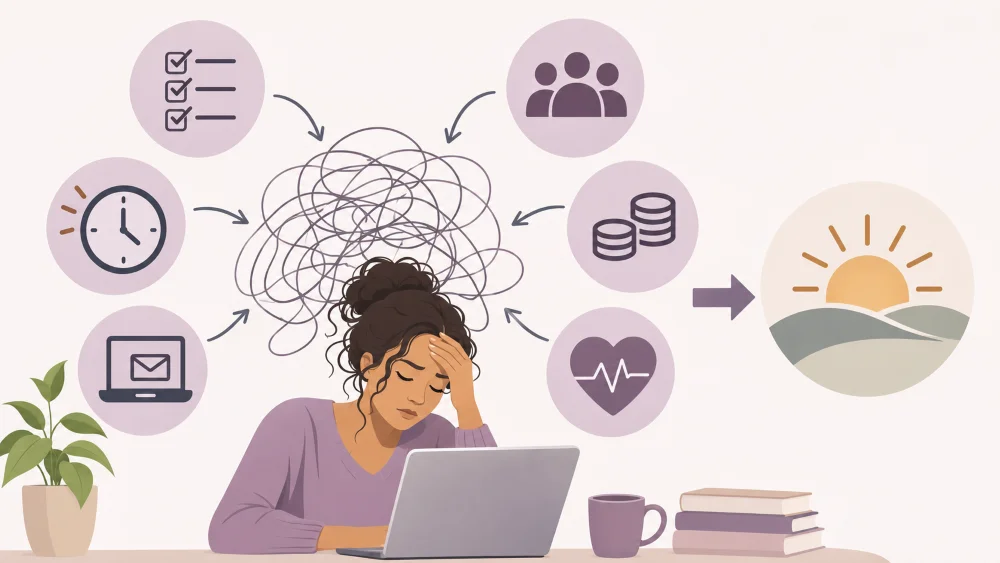
Underneath all of this I see three layers that pile up, and each of them feels different. Too much to track feels like noise and forgetting, too much to carry feels like pressure and short patience, and too much to choose feels like irritation at small decisions by the evening. A fourth thing, the loss of structure, sits beneath all three.
The 3-layer model of overload sets this out step by step, and the Reduce Overwhelm complete guide shows how the pieces fit together. Why More Productivity Often Increases Overwhelm explains why a new planner rarely helps when the real problem is how much is being carried.
Where to begin
You don't need to fix everything at once. If you would like to see where your own pressure comes from, the free Overwhelm Self-Assessment asks about mental load, decision load and structure on screen with no sign-up. My free Personal Reset Plan takes you through a whole reset day in a single sitting.
- In the head overwhelm looks like rereading, fog, feeling behind and a noisy mind. In the body it looks like quick reactions and dread when the phone lights up, and across the week it looks like routines that fade without anyone deciding they should.
- The thought that I should be able to handle it keeps capable women carrying more. Underneath it sit the three layers, too much to track, too much to carry and too much to choose.
IMPORTANT DISCLAIMER: This post describes everyday overwhelm and is not a diagnosis. I am not a doctor, therapist or certified coach, so if you are experiencing significant distress, anxiety, depression, burnout or other mental health concerns, please speak with a qualified healthcare professional.