Overthinking and overwhelm are easy to mix up, they feel alike because your head is busy and you can't settle or you feel tired. For more than ten years I dealt with both, chronic overwhelm and overthinking, and for a long time I treated them as the same thing, which is why I wanted to write about the differences how I see them.
Yes, overthinking and overwhelm are related but they respond to different things. Reading this will give you a simple way to tell which one you are dealing with, how they feed each other and what to do for each, using the methods I explain in my Overwhelm Reset Guide.
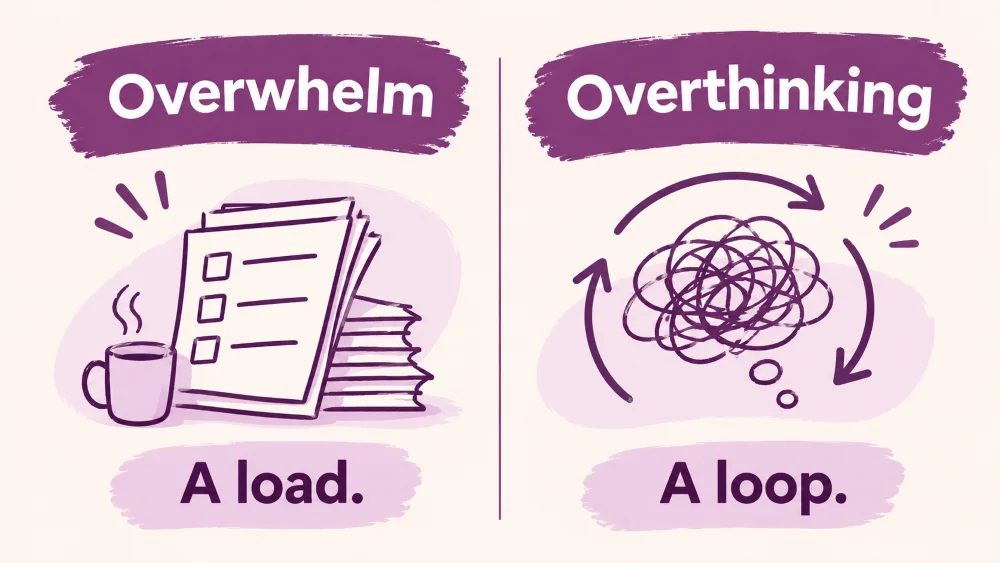
- Overwhelm is a load: too much to track, carry and choose. Overthinking is a loop: the same thoughts going round.
- A load needs reducing and a loop needs interrupting, so the same advice does not work for both.
- Three quick questions show which one you have, and they often feed each other.
- If it is both, start with the load and then use the loop tools.
Why they feel the same
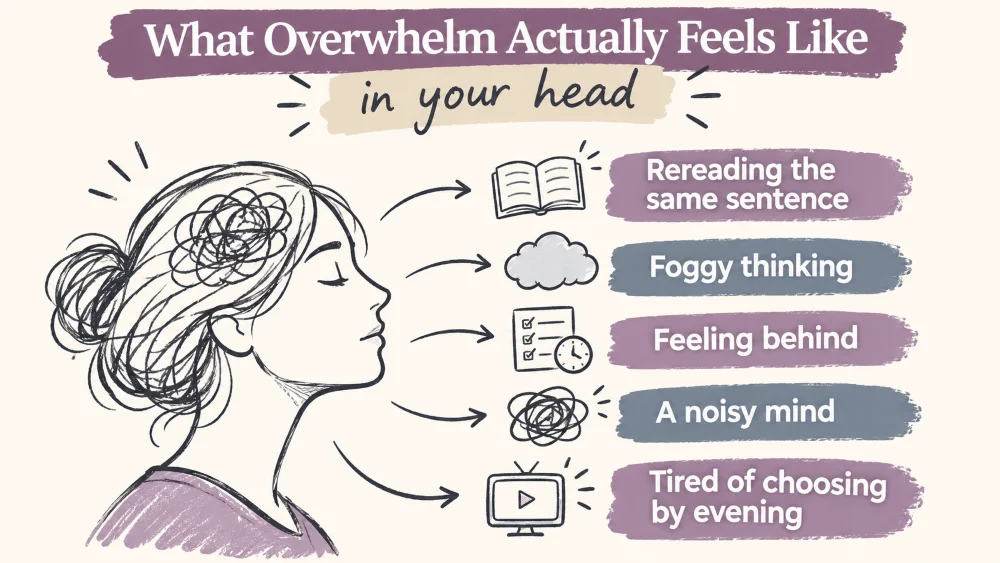
What I have found from experiencing both is that they leave your mind noisy and make small things harder. The Overwhelm Reset Guide lists the experience of overwhelm as tiredness that sleep does not fix, shorter patience, foggier thinking and simple things that start to feel heavy. Overthinking can produce the same list, because a mind that keeps replaying a problem can also become a tired mind.
My aim is to provide enough clarity to stop second-guessing yourself and my reset guide shows how second-guessing is an overthinking habit, and it grows when the load is high.
The difference
In the terms this site uses:
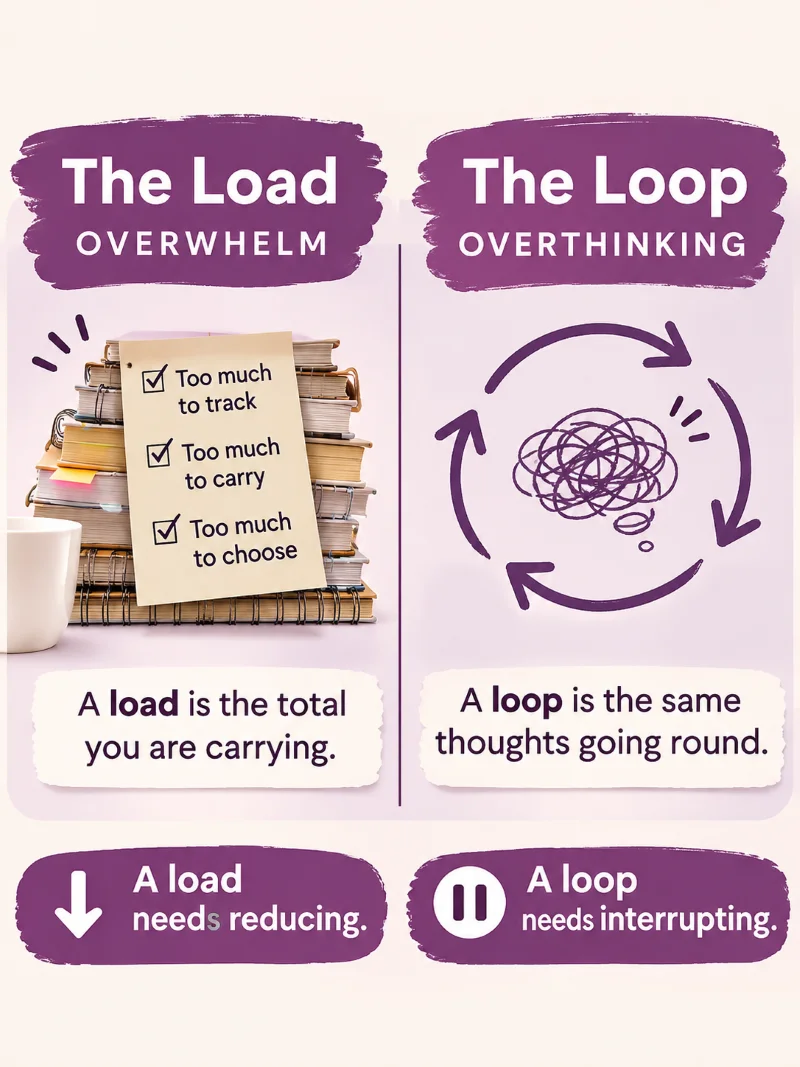
- Overwhelm is a load. It is the total you are carrying: too much to track, too much to carry and too much to choose. The guide calls it a load issue and not a personality issue.
- Overthinking is a loop. It is the same thoughts going round, often about a pressure that has never been questioned. The guide describes some pressures as mental loops that have never been questioned.
A load needs reducing and a loop needs interrupting. That is why the same advice does not work for both: removing a commitment lowers a load, and it will not stop a loop about something that has already happened that you keep playing in your head.
Overwhelm: a load
- Many things at once
- Mostly ahead of you: tasks and appointments
- Writing it down makes you feel lighter
- Needs reducing
Overthinking: a loop
- One thing turned over and over
- Mostly behind you: replaying or imagining
- Writing it down does not stop it returning
- Needs interrupting
A quick test
Write down what is on your mind right now, then ask three questions.
- Is it many things or one thing? A long list of unfinished items points to overwhelm. One question you keep turning over points to overthinking.
- Is it ahead of you or behind you? Open tasks and appointments are load. Replaying a conversation or imagining outcomes is a loop.
- Does writing it down lighten it? If a brain dump makes you feel lighter, it was mostly load. If you write it down and the thought keeps coming back, it was mostly a loop.
Load or loop? Answer for what is on your mind now
- Is it many things or one thing?
- A long list of unfinished items
- One question I keep turning over
- Is it ahead of you or behind you?
- Open tasks and appointments
- Replaying a conversation or imagining outcomes
- Does writing it down lighten it?
- Yes, I feel lighter
- No, the thought keeps coming back
Mostly a load: overwhelm
Reduce it. Empty your head onto the page, then choose what leaves the list.
Read the brain dump guideMostly a loop: overthinking
Interrupt it. Question the pressure, pre-decide the choices you keep reopening and single-task for a set time.
Read about decision saturationI would run myself through rating my mental load, decision load and structure from 1 to 10 because it helped me reduce my overthinking and I got really good at doing that in the moment. After a little practice it really isn't difficult, and what I found is a high mental load with low structure is overwhelm. If all three ratings are moderate and my head is still busy, look at overthinking. The free Overwhelm Self-Assessment walks you through the ratings on screen.
How they feed each other
When you are overloaded, you have less room to think clearly, and you are more likely to circle on a decision. The guide notes that decision fatigue makes even simple choices feel heavy by the evening, and a tired mind finds it harder to close a question. The Hidden Cost of Decision Saturation goes into this layer.
It works in the other direction too. Unmade decisions stay active in the mind, and a loop that runs for days adds to the mental noise. So reducing load often quiets the loop a little, and interrupting the loop frees up energy.
I remember being in the kitchen one day and there were three or four half finished pieces of work waiting for me to look at but my son had forgotten to tell me he needed his costume finished for the school play he was in, the sink was full of unwashed dishes and my best friend had sent a text wanting to chat about something. And it wasn't even 8am yet!
So, as usual my brain went into overdrive "I need to finish the first two of those reports before the 10am meeting and I forgot about the costume so really that needs looking at first, but I can't stand looking at all that dirty crockery plus I really want to know what Julie (my best friend) wants to tell me."
That's me overthinking. What was my usual way of operating and in that moment I began to feel what I can only describe as mild panic as I tried to figure out what to do first and that is overwhelm. My overthinking was playing into the hands of my overwhelm not helping it.
I taught myself the difference by understanding that if my mind was racing but I felt calm I was overthinking but if my mind was racing and I felt like I was about to go into a full blown meltdown then I was overwhelmed.
What helps with overthinking
When I was overthinking I found that loops responded well to questions, containment and one task at a time. I would:
- Question the pressure. I asked three things about each source of pressure: is it spoken or assumed? Is it current or carried from the past? Is it realistic or perfection-driven? The guide notes that some pressures require action and others are mental loops that have never been questioned.
- Change the sentence. Instead of saying, I am overwhelmed, I'd say my system is overloaded. One feels personal and the other feels solvable. The shift also moved me from pressure to curiosity, and the guide points out that curiosity creates space.
- Pre-decide. Choose a rule for the decisions you keep reopening. So instead of asking, what do I feel like doing, I'd ask, what did I already choose?
- Single-task for a set time. It really helped me if I chose one task, set a timer for a set amount of time (I started with 10 minutes) and remove visible distractions. When I find my mind wandering I would gently bring it back. The guide says attention is a skill that grows with repetition, and that self-criticism is not part of it.
Question one loop
- What is the one thought you keep turning over?
- Is the pressure behind it spoken or assumed?
- Is it current or carried from the past?
- Is it realistic or perfection-driven?
- What rule could you pre-decide so you stop reopening it?
What helps with overwhelm
A load responds to reduction. I also find focusing on one task only immediately reduces that panic feeling of having too much to do, I still do that now with lists. When I look at a long list I begin to feel the sensation of going into overwhelm so I tell myself "Eva, just focus on the first task" and I feel it subside. So I encourage you to empty your head, remove one commitment and give the week a shape to see how that helps.
- Empty your head. How to Do a Brain Dump That Works When Your Head Is Full shows how to get everything onto the page, label it and choose what leaves the list.
- Remove one commitment. How to Say No Without Guilt When You Are the Dependable One covers the capacity check and the limits that keep the load down.
- Give the week a shape. Why Weekly Structure Prevents Relapse Into Overwhelm sets out a short weekly review that stops the load rebuilding.
The 3-layer model of overload helps you see which of the three layers to reduce first.
If it is both
I always found that I didn't have one or the other I experienced both at the same time so I'd start with the load, because it is the easier of the two to reduce and it gives your mind more room to work with. Then use the loop tools on whatever thought is still going round. The signs that the load is building tend to show up before the loops get loud, and Early Warning Signs of Overwhelm lists them.
I created a free Personal Reset Plan which is built based on what I still do to help me with both of these because its not like they go away, I have just been able to learn how to manage both very quickly in the moment so they don't take over. The plan is the quickest way to start and it walks you through emptying your head, removing one commitment and rebuilding your week in one sitting, with no sign-up.
- Overwhelm is a load that needs reducing. Overthinking is a loop that needs interrupting.
- Ask whether it is many things or one, ahead or behind you, and whether writing it down lightens it.
- When it is both, reduce the load first and then use the loop tools.
IMPORTANT DISCLAIMER: This is a self-help guide for everyday overwhelm. I am not a doctor, therapist or certified coach. If your thoughts feel unmanageable or your distress lasts for weeks, please speak with a qualified healthcare professional.