If you cope well on the outside but your head is never quiet, this page is for you. It explains why overwhelm builds in capable women who carry a lot, how to tell which part of your load is causing it, and where to start lowering it. More effort and another planner may not have helped so far because they add to the load instead of lowering it.
Reduce Overwhelm: The Complete Guide
This guide is written by Eva Mandy, who lived with chronic overwhelm for more than ten years. She tested these methods on her own life and shares what helped. She is not a doctor, therapist or certified coach, and this is a self-guided tool for everyday overwhelm. If you need medical or therapeutic support, please speak to a qualified professional.
What is overwhelm?
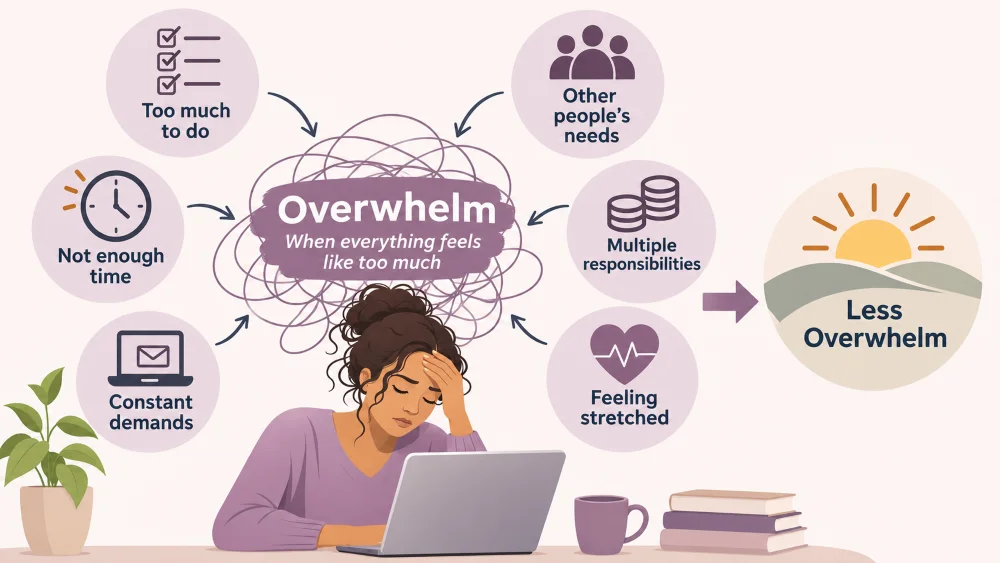
Overwhelm is the feeling that what you carry is more than you can hold. From the outside you may look fine: you answer messages, show up and get things done. Inside, your head stays busy and small tasks feel heavy.
Common early signs:
- You read your to-do list again and again without starting
- Small requests irritate you more than they should
- You lie awake running through tomorrow
- You say yes, then regret it by evening
- Simple choices, like what to cook, feel like too much
- Rest does not feel restful
The three layers of overload, and where to begin
Layer 1
Too much coming in
Messages, requests, family coordination and unfinished tasks all take up space in your head. Getting them onto paper shows you how big the pile is.
Layer 2
Too many decisions
Every small choice, from what to cook to how to reply, draws on the same energy. Making some of them once, ahead of time, gives that energy back.
Layer 3
Nothing holding it together
When routines, boundaries and weekly reviews fade, your head tries to track everything. A simple weekly shape does that job for you.
Start here
Do a one-day reset
Empty your head, remove one commitment and rebuild your week. The Personal Reset Plan is free and needs no sign-up.
Why more effort does not fix it
When overwhelm rises, the usual response is to find a better system. You download a new planner, rearrange your calendar or try to work faster.
The trouble is that these tools help you get through tasks, and they rarely ask whether there are too many tasks. When you clear space, the space tends to fill again. You end up quicker, still carrying the same load.
Lowering the load works differently. You look at what you have said yes to, remove or shrink some of it, and then give the week a shape that does not rely on your memory.
How overwhelm builds without you noticing
Overwhelm can feel sudden, as if one week was fine and the next was too much. Usually it builds slowly. You say yes one extra time. You skip the weekly check-in. You take on one more responsibility because you can.
Each step is small. Together they change the shape of your week, and your head starts tracking everything because nothing outside it is doing that job. This site calls the slow version structural drift.
The useful part is that a slow build can be reversed with small, regular steps.
Where to start this week
You do not need to fix your whole life. Start with one reset day:
- Empty your head. Write down everything that feels unfinished, then label each item as something to act on, something you are waiting for, or something to let go.
- Remove one commitment. Pick one heavy item and remove it, delay it or make it simpler.
- Give your week a shape. Choose three anchor points: a wake-up window, a block of focused work and a protected rest window.
The free Personal Reset Plan walks you through these three steps. If you want a full week of guided steps, the Overwhelm Reset Guide below takes you through one small step a day.
Read the full articles
Why Capable Women Experience Overwhelm
Why the most dependable women often carry the most, and the structure that brings relief.
How Structural Drift Creates Mental Chaos
How routines, boundaries and review habits fade slowly, and how a weekly check stops it.
Why More Productivity Often Increases Overwhelm
Why another planner or system can add load instead of removing it.
The 3-Layer Model of Overload: Input, Decisions, and Structure
Too much to track, too much to choose and no structure holding it together. See which layer is yours.
Early Warning Signs of Overwhelm (and What to Do When You Spot Them)
The small signs that overwhelm is building, and how to write a response to each one in advance.
How to Do a Brain Dump That Works When Your Head Is Full
How to empty your head onto the page, label what you wrote and remove one thing from the list.
What Overwhelm Actually Feels Like: Signs in Your Head, Body and Week
What overwhelm feels like in your thinking, your body and your week, and a two-minute check to see where yours comes from.
How to Say No Without Guilt When You Are the Dependable One
A capacity check, three limits you can keep and the words to use when everyone relies on you.
Overthinking vs Overwhelm: What Is the Difference and Which Do You Have?
How to tell a heavy load from a thought loop, and what to do for each.
The full 7-day reset
The Overwhelm Reset Guide
An interactive 7-day reset for capable women over 30. You work through it on this site, one screen at a time, taking one small step a day. Your answers are saved as you go, and you can download or print everything you wrote.

Quick answers about overwhelm
Why do I feel overwhelmed when nothing is actually wrong?
Overwhelm usually comes from the total amount you carry, not from one event. Many small commitments, decisions and open tasks add up even when each one is fine on its own. Why capable women experience overwhelm
Why does a new planner or system make it worse?
A planner helps you get through tasks faster, but it does not ask whether you have too many. Cleared space tends to fill up again, so you end up busier with the same load. Why more productivity increases overwhelm
What are the three layers of overload?
Too much coming in, too many decisions to make, and no structure holding the week together. Overwhelm often involves all three, so treating only one can bring brief relief that fades. The 3-layer model of overload
What is structural drift?
It is the slow loosening of routines, boundaries and weekly reviews while commitments keep growing. Nothing dramatic happens, but your head ends up doing the tracking. How structural drift creates mental chaos
How do I stop being the person everyone adds to?
Start by seeing what you already carry, then decide what you will say yes to before the request arrives. Clear boundaries are easier to keep when they are set in advance. Boundaries for responsible women
Frequently asked questions
Who is this for?
Capable women over 30 who carry a lot at work, at home and in the community. You cope well on the outside, your head is never quiet, and more effort or another planner has not helped.
Do I have to buy anything to start?
No. The Personal Reset Plan is a free one-day plan that needs no email address. The Overwhelm Reset Guide is the full 7-day version for anyone who wants more support.
Is this a treatment for anxiety or burnout?
No. This is a self-guided tool for everyday overwhelm. Eva Mandy is not a doctor, therapist or certified coach. If you are experiencing significant distress, anxiety, depression or burnout, please seek guidance from a qualified healthcare professional.
How long does the reset take?
The Personal Reset Plan is built to be done in one day. The Overwhelm Reset Guide takes 7 days, with one small step a day, and then a weekly reset of about 20 minutes to keep things steady.
Will overwhelm come back?
At times, yes. Busy seasons and emotional seasons happen. The aim is faster recovery, which is why the reset is short enough to repeat whenever you notice the load building.
Who wrote this?
Eva Mandy, who lived with chronic overwhelm for more than ten years. She tested these methods on her own life and shares what helped.
A question to take with you
If you wrote down everything you are carrying right now, which one item would you be relieved to cross off?